Why the cheapest supermarket isn't always the cheapest for you
Aldi, Lidl, REWE or EDEKA? The more useful question is not which retailer is cheapest overall – but where your personal shopping basket actually costs less.
17 August 2026 · 7 min read · BonBert RedaktionWhy the cheapest supermarket isn't always the cheapest for you
Which supermarket is actually the cheapest?
It sounds like a question that should have one simple answer.
Discount retailer A? Supermarket B? Maybe whichever store has the most promotions this week?
In everyday life, however, there is a much more useful question:
Which retailer is cheapest for your shopping?
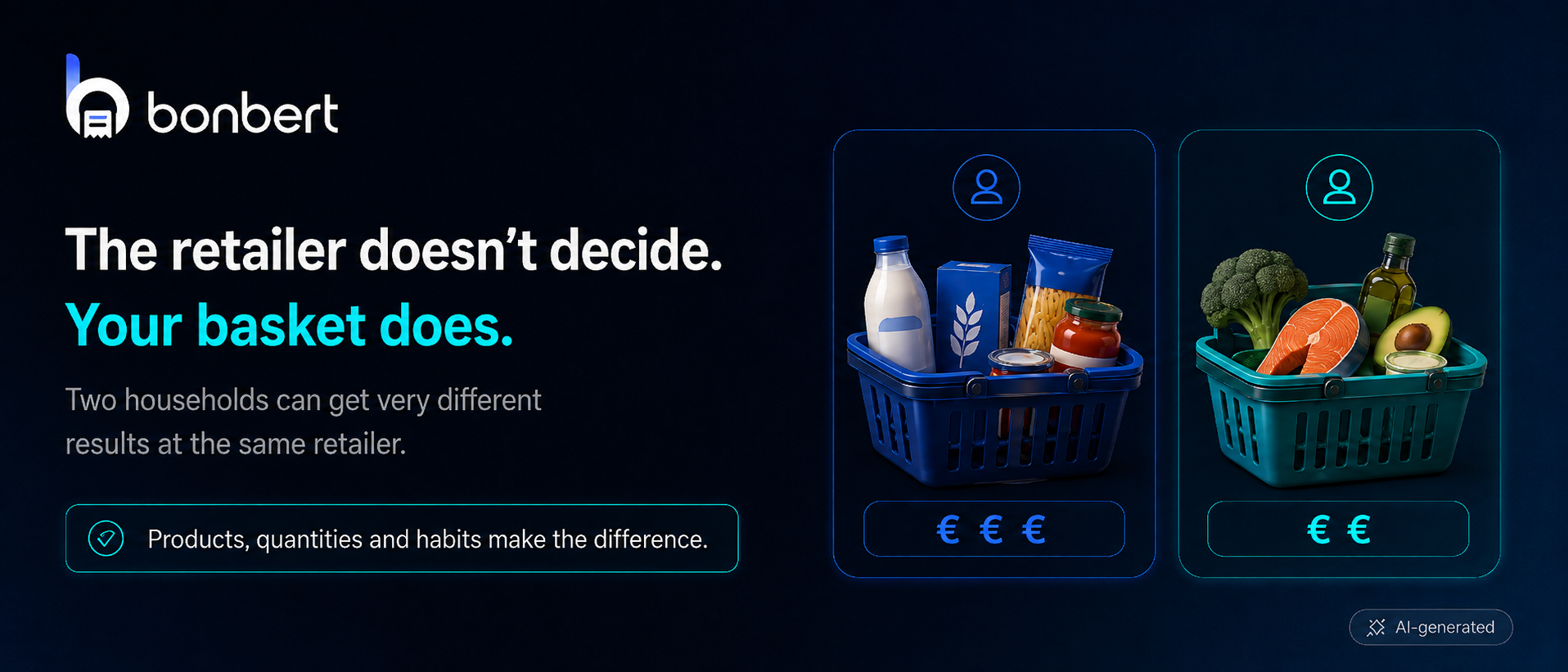
You do not buy an average basket. You buy milk, coffee, butter, shampoo, tomatoes, drinks and the products that fit your household.
That means a retailer commonly perceived as inexpensive can still be more expensive for your personal basket.
“The cheapest supermarket” is difficult to define
To properly compare two retailers, we would have to buy exactly the same products from both at exactly the same time.
That is where things already become complicated.
Your preferred butter might only be available at one retailer.
At another store, you may choose a private-label alternative.
One pack contains 400 grams while another contains 500 grams.
Coffee happens to be on promotion this week.
And you may spontaneously choose a different shampoo because of the price.
In reality, we are therefore often not comparing two identical shops.
We are comparing two different shopping baskets.
Your basket matters more than a general ranking
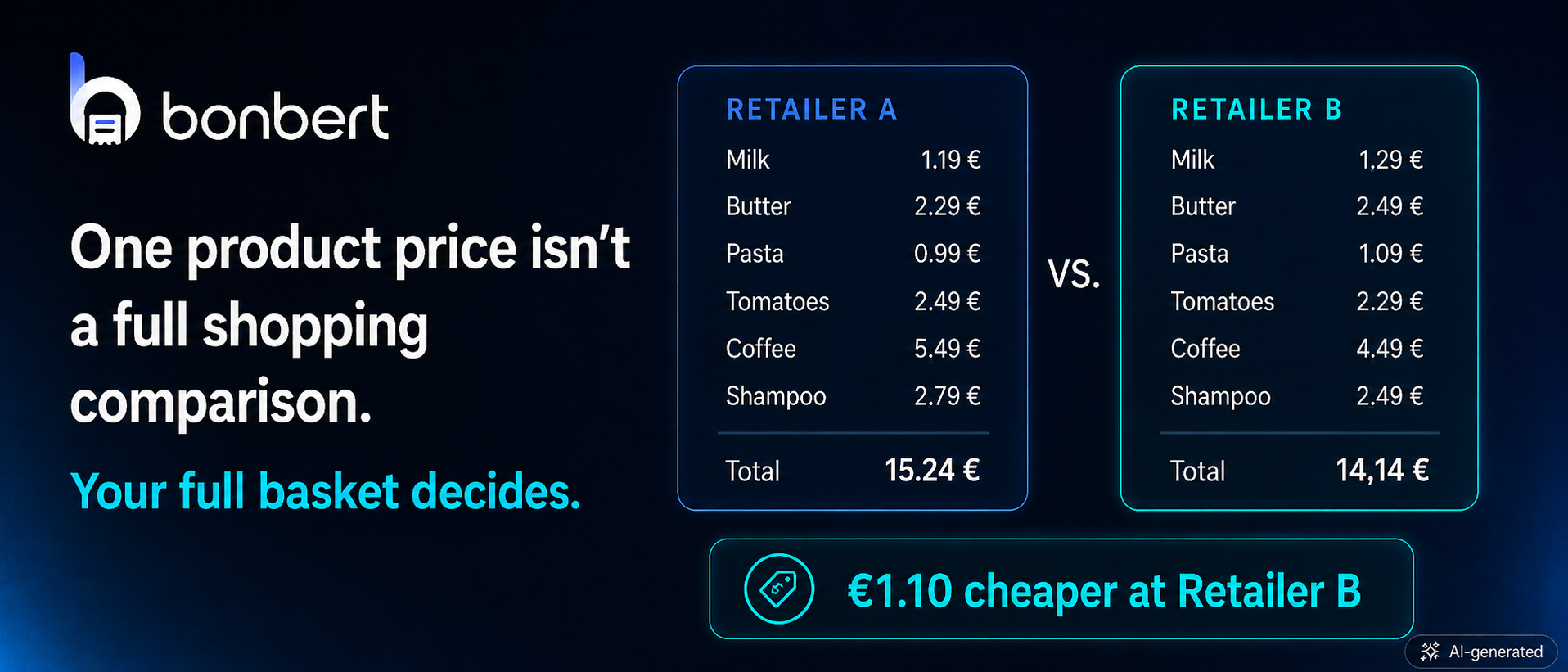
Imagine two fictional retailers.
A small basket could look like this:
| Product | Retailer A | Retailer B |
|---|---|---|
| Milk | €1.19 | €1.29 |
| Butter | €2.29 | €2.49 |
| Pasta | €0.99 | €1.09 |
| Tomatoes | €2.49 | €2.29 |
| Coffee | €5.49 | €4.49 |
| Shampoo | €2.79 | €2.49 |
| Total | €15.24 | €14.14 |
Retailer A is cheaper for three products.
Yet the entire example basket costs €1.10 less at Retailer B.
The example is deliberately simplified, but it demonstrates the underlying problem:
The number of cheaper products does not determine the cheapest shop. What matters is what you buy and how much those products contribute to your total.
Pack size can change the picture
€2.09 initially sounds cheaper than €2.49.
But imagine:
- Product A: 400 g for €2.09
- Product B: 500 g for €2.49
Product A costs around €5.23 per kilogram.
Product B costs around €4.98 per kilogram.
In this example, the product with the higher shelf price is actually cheaper relative to quantity.
That is why unit prices matter.
They make it easier to compare products sold in different pack sizes.
Promotions keep changing the comparison
Then there are promotional prices.
Coffee might cost €5.49 today and considerably less on your next visit.
Butter may be cheaper at Retailer A this week, while Retailer B runs a promotion next week.
The question
“Which supermarket is cheapest?”
quickly becomes:
“Where were the products I actually buy cheaper recently?”
That is a very different type of price comparison.
Brands matter too
Many comparisons become difficult because they are not comparing the same products.
A branded yoghurt cannot simply be treated as identical to a private-label product if you personally only buy one of them.
The same applies to:
- particular coffee varieties
- organic products
- vegetarian or vegan alternatives
- products for allergies or intolerances
- preferred brands
- specific pack sizes
- household and personal-care products
For your personal shop, the fact that a theoretically cheaper alternative exists somewhere is not necessarily the most useful information.
The first question is:
What do you actually buy?
Your purchasing frequency changes the calculation
Things become even more interesting across several weeks or months.
You may buy coffee once a month.
Milk, however, might go into your basket several times a week.
A ten-cent difference on a frequently purchased item may therefore matter more over time than a two-euro difference on something you buy twice a year.
A genuinely personal price comparison would ideally understand:
- which products you buy regularly
- how frequently you buy them
- which quantities you purchase
- how much you actually paid
- where you bought them
- how those prices change over time
A seemingly simple price comparison quickly becomes a data problem.
This is where receipts become interesting
A receipt contains exactly this kind of information.
Retailer.
Date.
Products.
Quantities.
Prices.
Discounts.
And most importantly:
the price you actually paid.
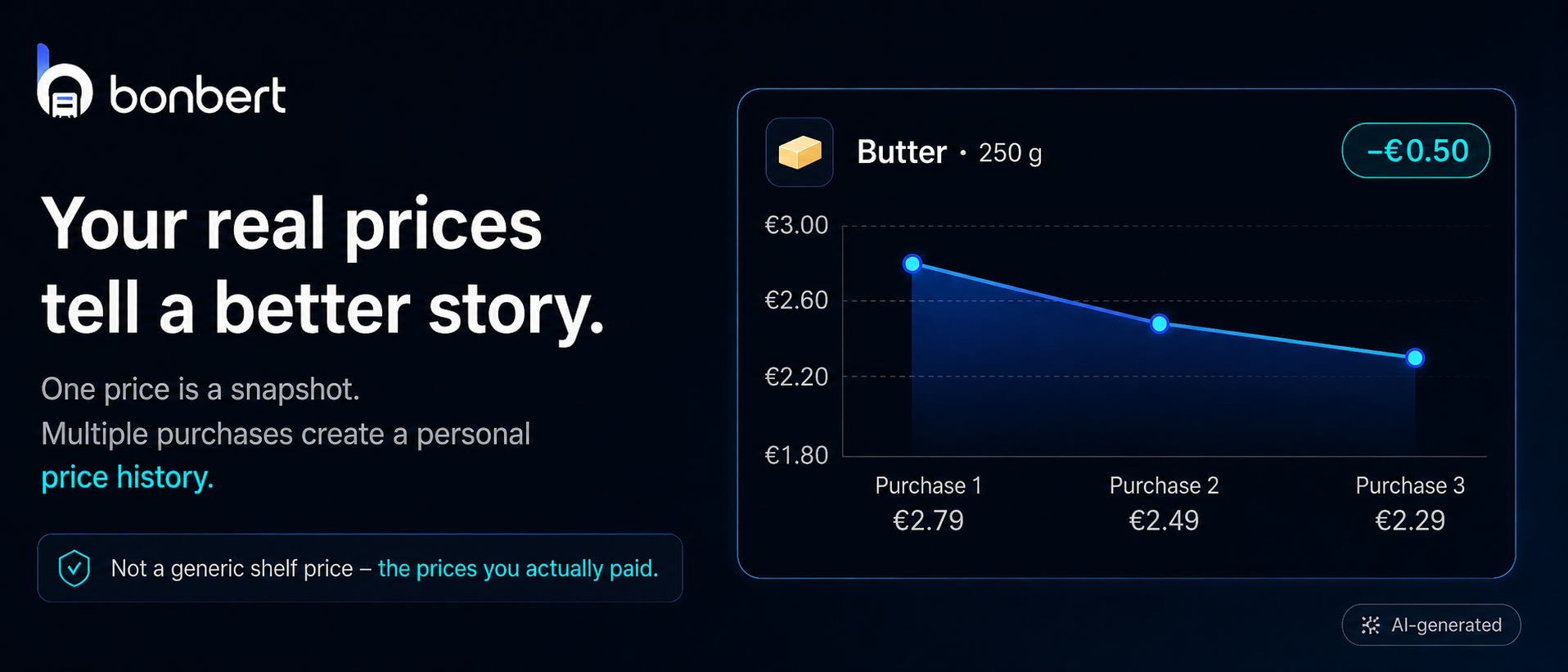
A single receipt is only a snapshot.
Many receipts can become a personal price history.
Instead of simply seeing:
Butter – €2.79
you may eventually see:
Butter – last purchase €2.79 previous purchase €2.49 another retailer €2.29
That creates a price comparison that is not based on a theoretical standard basket.
It is based on your shopping.
BonBert therefore starts with your actual purchase prices
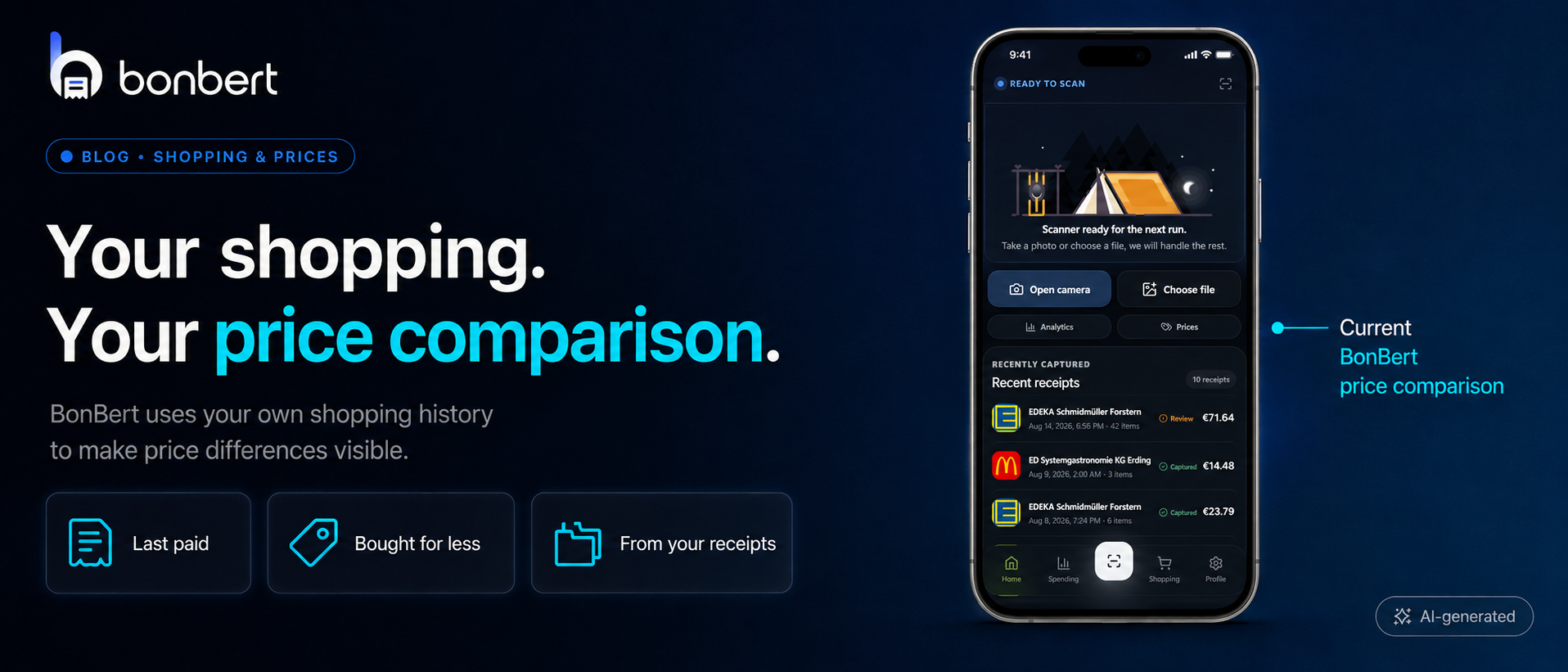
This is the idea behind BonBert's personal price comparison.
As you capture receipts, BonBert gradually builds a shopping history from retailers, products, prices, quantities and categories.
That can make price differences visible for products that genuinely appear in your shopping history.
For us, this distinction matters.
We do not simply want to tell you:
“Retailer X is the cheapest.”
A much more useful observation might be:
“You bought this product for less on a previous shop.”
or:
“There are noticeable price differences in your history for an item you regularly purchase.”
BonBert's personal price comparison currently uses your own shopping data. A broader local retailer price comparison is being expanded step by step.
A useful price comparison should be explainable
We also believe that a savings suggestion should not simply appear from nowhere.
If BonBert identifies a price difference, it should remain understandable what the suggestion is based on.
For example:
- one of your previous purchases
- the recognised product price
- the retailer
- the pack size
- the date of the purchase
A message such as
“You could save here”
is far more useful when you can understand why.
The cheapest retailer can change with every shop
Retailer A may work particularly well for your normal weekly basket.
If you suddenly need coffee, detergent and drinks, the calculation may look very different.
And for a small shop containing milk, bread and bananas, another retailer may come out ahead again.
That is why the idea of one permanently “cheapest supermarket” is less interesting to us than the question:
Which shop was actually good value for you?
Price isn't the only factor
Of course, the final cent is not the only thing that determines a good shopping decision.
Other factors also matter:
- distance
- travel costs
- time
- product selection
- quality
- availability
- personal preferences
Driving across town to save 80 cents may not be a particularly smart decision.
BonBert should therefore not simply produce as many tiny price alerts as possible.
The goal is to derive useful information from your shopping data.
From the cheapest supermarket to smarter shopping
Perhaps the original question is the wrong one.
Instead of asking:
Which supermarket is cheapest?
we could ask:
How can I make my own shopping cheaper?
We do not need to know every grocery price in Germany to start answering that question.
We can begin with something that already exists after every shop:
your receipt.
Your own purchases tell us which products are actually relevant to you.
Conclusion
There is not automatically one cheapest supermarket for your everyday life.
Pack sizes differ.
Promotions change.
Products and brands differ.
And most importantly, every household buys a different basket.
Price comparison therefore becomes much more useful when it focuses on your own shopping rather than a theoretical average household.
That is why BonBert works with the prices found on your receipts.
Over time, individual shops can become a personal price history – creating the foundation for a much more useful question:
Not: Where is everything cheapest?
But: Where can you make smarter decisions on the things you actually buy?
More from BonBert
Want to understand how your grocery spending compares?
→ How much do households in Germany spend on groceries?
Want to know why BonBert prioritises recognition quality when scanning receipts?
→ Receipt scanning: Why BonBert focuses on recognition quality
All prices used in the examples in this article are fictional examples and do not represent current retailer prices.
Image notice: AI-generated illustrations used in this article are labelled accordingly.