What's still in your pantry? Why shopping planning starts with the receipt
What you already bought matters just as much as your shopping list. How receipt data can help infer pantry items, reduce duplicate purchases and use fresh food in time.
1 September 2026 · 8 min read · BonBert RedaktionWhat's still in your pantry? Why shopping planning starts with the receipt
A shopping list usually answers one question:
What do we still need?
But another question is just as important:
What do we already have?
That turns out to be surprisingly difficult in everyday life.
There may be a yoghurt at the back of the fridge. Another packet of pasta may still be in the cupboard. The tomatoes from the last shop should probably be used soon – but by the time you are in the supermarket again, they are no longer top of mind.
That is how duplicate purchases, forgotten food and unnecessarily large shops can happen.
Yet some of the information already exists:
on our receipts.
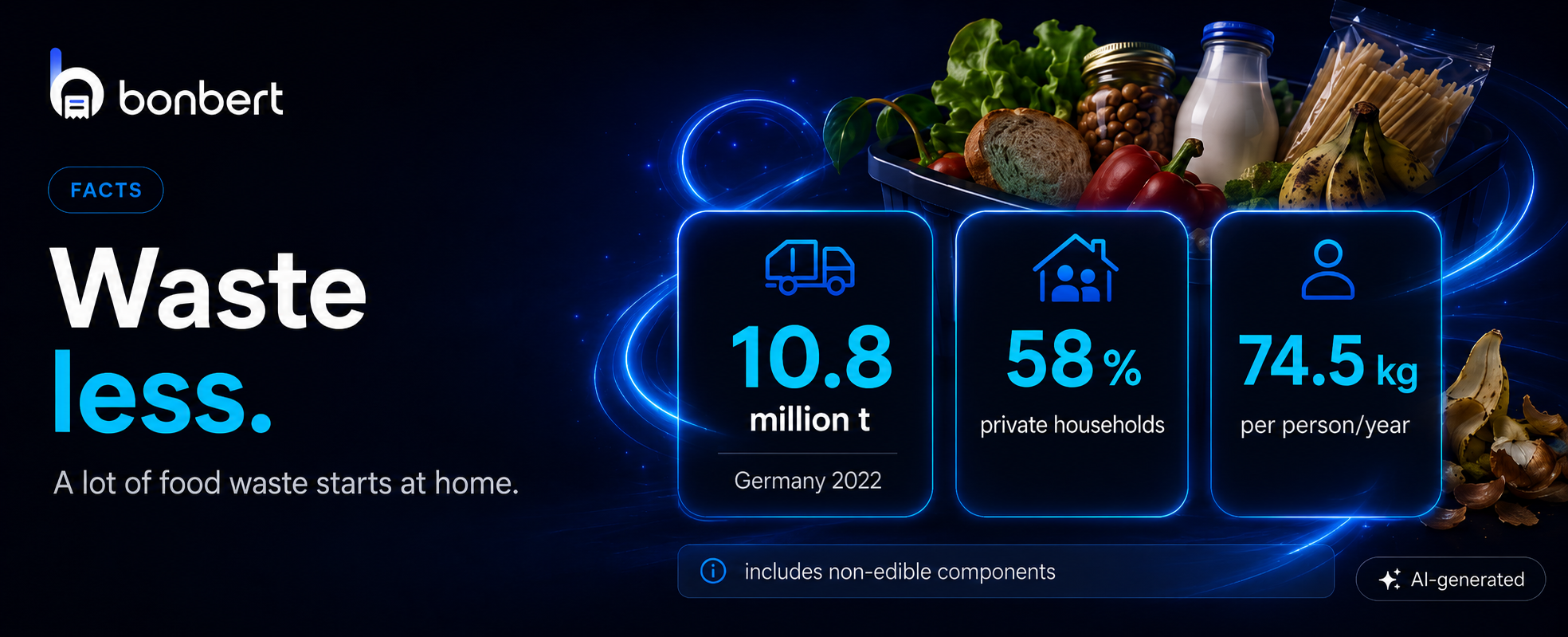
Germany generated around 10.8 million tonnes of food waste in 2022. 58% arose in private households. The 74.5 kg per person also includes inedible parts. Image: AI-generated.
58% of food waste arises in private households
Food waste is not only a problem in retail or restaurants.
According to currently published figures from Germany's Federal Ministry of Agriculture, Food and Regional Identity, around 10.8 million tonnes of food waste were generated in Germany in 2022.
The largest share – 58%, or around 6.3 million tonnes – arose in private households.
That corresponds to around 74.5 kilograms of food waste per person per year at household level.
One important distinction matters:
That number does not only describe avoidable waste. It also includes inedible parts such as fruit and vegetable peels, bones and coffee grounds.
At the same time, food that could potentially have been used is also thrown away.
The ministry mentions examples such as lettuce left too long in the fridge, cooking too much food or uncertainty after a best-before date has passed.
Fresh food is particularly relevant
Research into household food waste also shows that fresh fruit and vegetables make up a particularly large share.
According to findings from a GfK study summarised by the German Environment Agency, 35% of the food waste examined consisted of fresh fruit and vegetables.
That makes intuitive sense.
An unopened packet of pasta can stay in the cupboard for months.
Salad, berries or fresh herbs offer a much shorter window.
Useful shopping planning therefore needs more context than simply knowing what was bought at some point.
It helps to ask:
- When was it bought?
- Is it a fresh product?
- How often do we normally buy it?
- Could some of it still be available?
- Should it be used first?
Why manual pantry lists quickly become work
Of course, a pantry can be maintained manually.
A spreadsheet, notes app or dedicated inventory app can be highly accurate – if it is maintained consistently.
That is also where the extra work appears.
Every purchase needs to be added.
Every consumed item needs to be removed.
Quantities change.
Several people may use the same food.
And once the list has not been updated for a few days, its accuracy quickly falls.
BonBert therefore takes a different approach:
The pantry should be inferred as much as possible from something that already happens anyway – shopping.
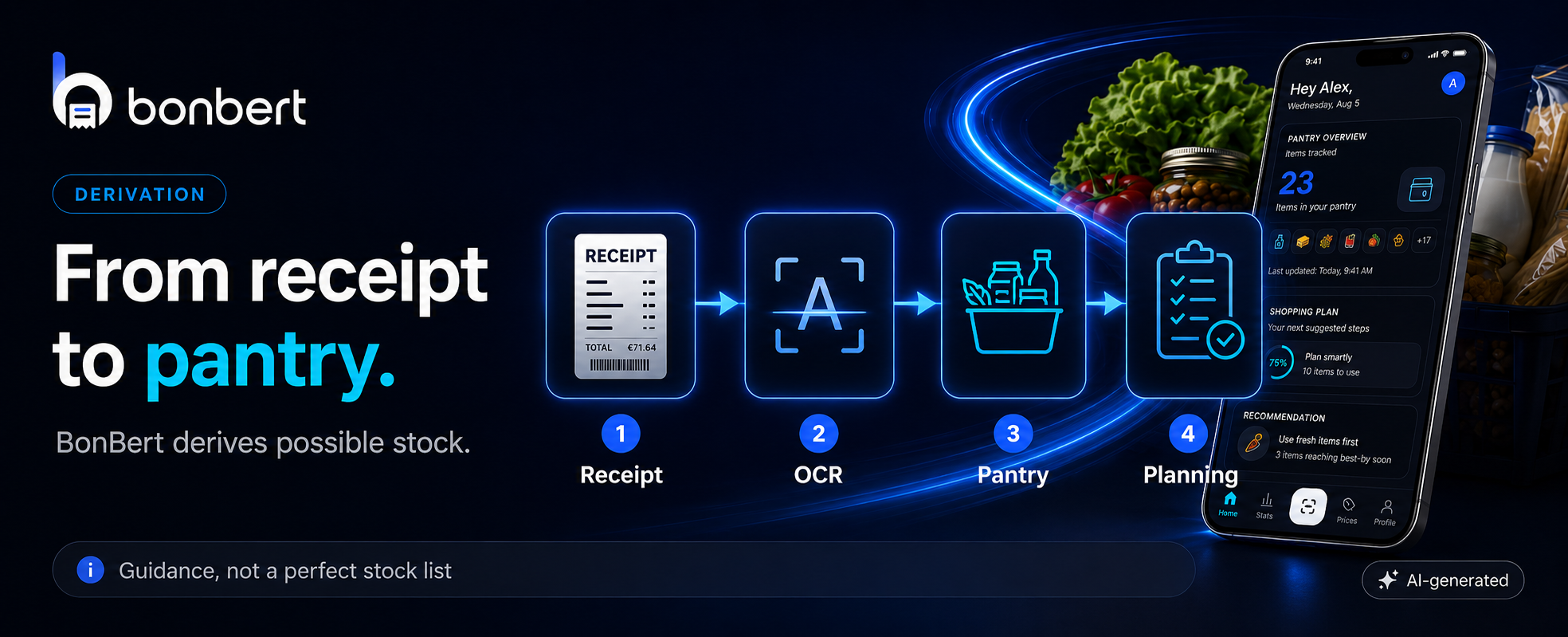
BonBert can infer what may still be available from real purchases. An inference is deliberately not a guarantee of actual stock. Image: AI-generated.
From receipt to possible pantry
A receipt already contains information that can be useful for pantry logic:
- retailer
- purchase date
- product
- quantity
- price
- category
If you buy four yoghurts on Monday, one thing is known:
Four yoghurts entered the household on Monday.
What BonBert cannot automatically know for certain:
- who ate them
- whether guests were there
- whether one was discarded
- whether all four are still available
That is why the word inference matters.
BonBert can build a probable pantry based on purchases and historical patterns.
That is different from a complete inventory.
And a useful product should make that uncertainty visible rather than pretending to know more than its data allows.
Shopping history can warn about duplicate purchases
A common everyday example is the duplicate purchase.
You are in the supermarket and wonder:
“Do we still have yoghurt?”
You are not sure.
So you buy more to be safe.
At home, two packs are waiting in the fridge.
One duplicate purchase is not a disaster.
Across many small shops, however, this pattern can contribute to food being forgotten or used too late.
BonBert's current product description explicitly includes this type of use case:
A possible duplicate purchase can be identified from your own receipts.
The word possible matters.
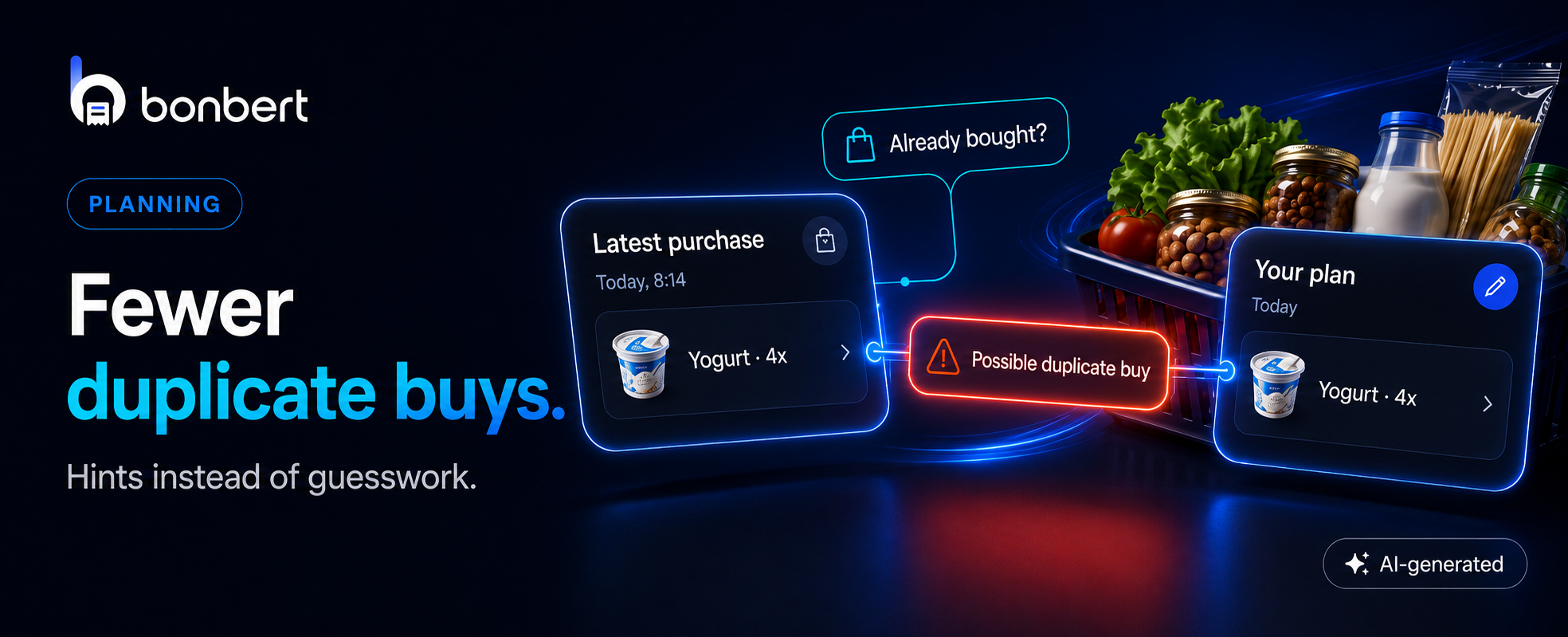
A previous purchase can provide a reason to check whether an item may still be there. It does not prove that it is. Image: AI-generated.
Good insights need uncertainty
An app should not claim:
“You still have four yoghurts in your fridge.”
when all it actually knows is that four yoghurts were bought three days ago.
A more useful message would be:
“You bought this item three days ago. It may be worth checking whether any is still left.”
It sounds less dramatic.
But it is much more useful.
That reflects an important BonBert principle:
Insights should be grounded in understandable evidence.
Not invented certainty.
Fresh spinach needs different priority from pasta
Not every pantry item is equally urgent.
A packet of rice usually does not need to be consumed tomorrow.
Fresh spinach may.
According to BonBert's current product description, fresh products can therefore be prioritised so they are used in time.
That connects two areas that are often separated in traditional shopping lists:
buying and using.
Good shopping planning is not only about buying new things efficiently.
It also means:
using what you have already paid for.
Your pantry can become the next meal
Once there is an idea of which products may be available, another question becomes possible:
What could we cook with them?
BonBert now also offers meals based on the inferred pantry and can take missing ingredients and expected cost into account.
That changes the usual order.
Traditional planning:
Choose recipe → create ingredient list → buy everything
Pantry-first planning:
Check pantry → find fitting meal → buy only what is missing
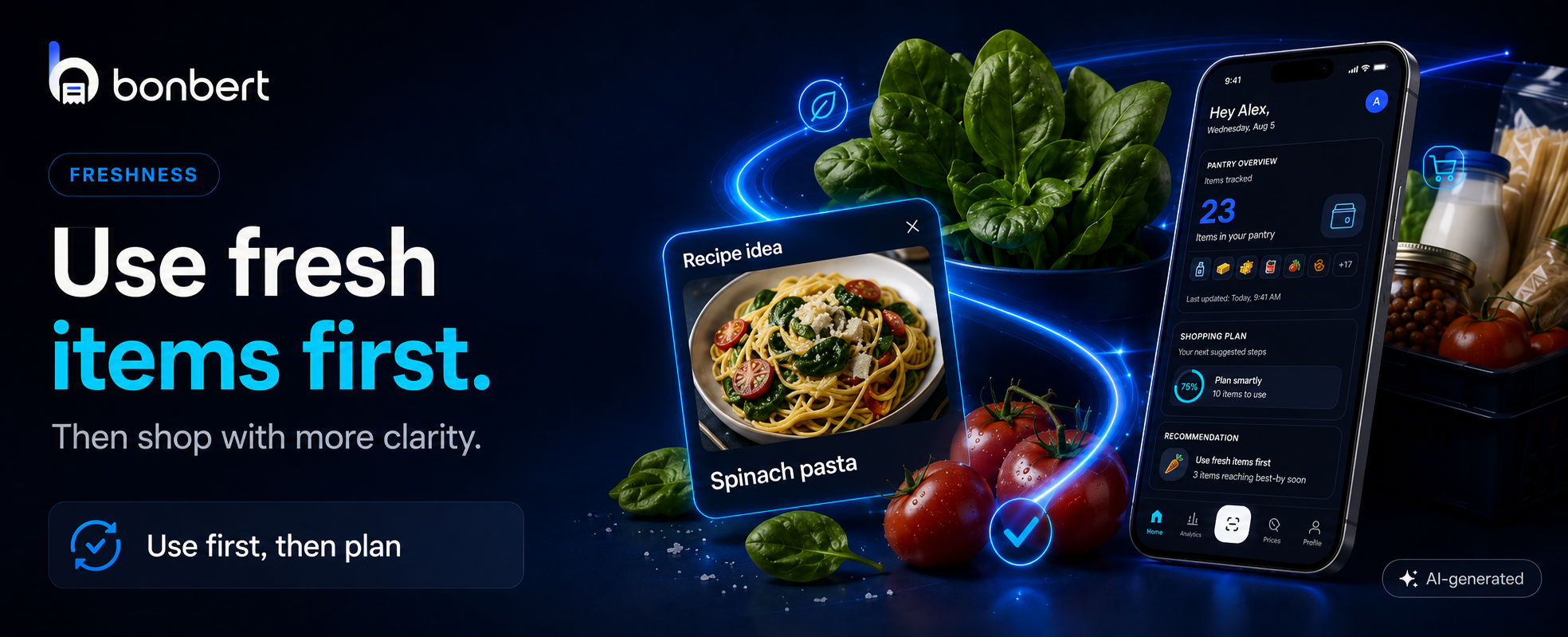
Shopping planning can connect pantry, freshness and the next meal. Image: AI-generated.
The benefit is not only less waste
Pantry-oriented planning can potentially help in several ways.
Fewer duplicate purchases
Previous purchases create a reason to check before buying another one.
Fewer forgotten fresh products
Food with a shorter useful life can be brought forward.
Shorter shopping lists
If existing ingredients are taken into account, every meal does not need to start from zero.
Better use of the shopping budget
Food that was paid for and then forgotten still costs money – regardless of whether it was a good deal.
That is also why saving is not only about price comparison.
Not buying the same thing twice, or using it before it is wasted, can also create financial value.
Food waste is not only an individual responsibility
Another distinction is important here.
Food waste arises across the entire supply chain.
Agriculture, processing, retail and food service all have responsibilities too.
Germany's federal ministry likewise stresses that reducing food waste cannot rely only on changing consumer behaviour.
A household app therefore cannot solve the whole food-waste problem.
But it can help where there is a very practical information gap:
What did we buy – and what might still be available?
Why BonBert starts with the receipt
This is why pantry logic fits naturally with BonBert's product idea.
A receipt is not just proof of a total.
It describes a purchase.
And many purchases together create context.
From
“Monday: €32.80 at REWE”
you can gradually derive:
- which products were bought
- what they cost
- which categories they belong to
- what may still be available
- what might need to be used first
- whether an item appears again on the shopping list
- which meal could fit the inferred pantry
The receipt becomes more than a historical document.
It becomes part of the next decision.
Automatic pantry logic needs limits
It should still not pretend to be perfect.
A system cannot automatically observe every item in the kitchen.
These situations can all create differences:
- another household member consumes something
- food is given away
- an item is discarded
- only part of a quantity is used
- a purchase happens without a captured receipt
- food is consumed away from home
A useful pantry feature therefore needs to remain correctable.
And recommendations should be presented as probable insights, not absolute facts.
Conclusion: the next shopping list starts with the previous shop
Before asking:
“What do we need to buy?”
it is worth asking:
“What have we already bought?”
That is where a lot of useful shopping planning can begin.
Official figures show that private households play a major role in food waste.
Not all of that waste is avoidable.
But better planning, appropriate quantities and using food that is already there are among the levers highlighted by official food-waste initiatives.
BonBert therefore starts with the receipt.
Not to pretend it has a perfect digital inventory.
But to turn previous shopping into useful context for the next shop:
What may still be there? What should be used first? And what do we really still need?
More from BonBert
→ How much do households in Germany spend on groceries?
→ Why BonBert sometimes takes a few extra seconds to scan a receipt
Sources
German Federal Ministry of Agriculture, Food and Regional Identity (BMLEH), National Strategy for Food Waste Reduction: https://www.bmel.de/EN/topics/food-and-nutrition/food-waste/national-strategy-for-food-waste-reduction.html
BMLEH, household food-waste information: https://www.bmel.de/DE/themen/ernaehrung/lebensmittelverschwendung/aktivitaeten-lebensmittelverschwendung.html
German Environment Agency, Food waste: https://www.umweltbundesamt.de/themen/abfall-ressourcen/abfallwirtschaft/abfallvermeidung/lebensmittelabfaelle
BonBert product page: https://www.bonbert.de/en
The food-waste figures refer to 2022 and also include inedible parts.
Pantry information inferred by BonBert is an estimate based on captured purchases, not a complete physical inventory.
AI notice: AI-generated or AI-composed images used in this article are visibly labelled.